When a company refuses your IBAN because of its country code
Article 9 of Regulation (EU) No 260/2012 bars a company that collects euro direct debits, or pays or receives euro transfers, from requiring your account to be in a particular EU country. Write to the company quoting the article and keep the refusal. If that gets you nowhere, report it to the competent authority, starting with the one in the country where the company is based.
- What counts as IBAN discrimination
- Can an employer or utility refuse an IBAN from another EU country?
- IBAN not accepted for a reason other than its country
- How to complain to a company about IBAN discrimination
- Where to report IBAN discrimination
- Penalties for IBAN discrimination and how long a complaint takes
- IBAN from a payment institution or e-money account refused
- FAQ
What counts as IBAN discrimination
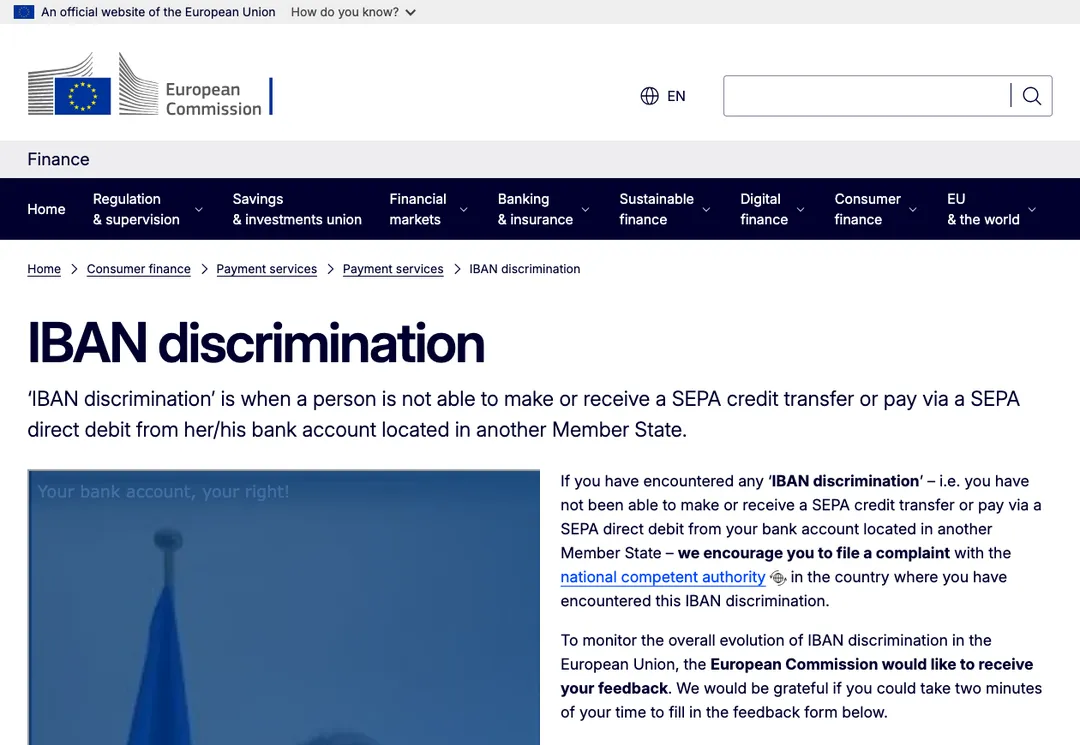
The European Commission's page on IBAN discrimination defines it as the situation where a person is not able to make or receive a SEPA credit transfer, or pay via a SEPA direct debit, from a bank account located in another Member State.
The rule behind that definition is Article 9 of Regulation (EU) No 260/2012, headed Payment accessibility. It has two paragraphs. The first says a payer making a credit transfer to a payee whose payment account is located within the Union shall not specify the Member State in which that account is to be located. The second says the same of a payee accepting a credit transfer, or using a direct debit to collect funds, from a payer whose account is located within the Union. The legislation.gov.uk links here open the text as adopted in 2012, without later amendments; the consolidated version of 8 April 2024 on EUR-Lex has Article 9 in the same words.
| What you were told | The other party's role | Paragraph of Article 9 |
|---|---|---|
| Your employer's payroll only pays into IBANs from its own country | Payer making a credit transfer | 9(1) |
| A shop or insurer will only send your refund to a domestic IBAN | Payer making a credit transfer | 9(1) |
| A utility's direct debit mandate rejects your IBAN | Payee using a direct debit | 9(2) |
| A company you owe money to only takes transfers from domestic accounts | Payee accepting a credit transfer | 9(2) |
The Banco de España's Portal for Banking Customers describes the same thing in a post dated 30 April 2025: a company, professional or public administration in an EU country refuses to receive payments or direct debits from an account whose IBAN doesn't correspond to that country. The post calls the practice illegal and says it contravenes Article 9.
Can an employer or utility refuse an IBAN from another EU country?
Under the two paragraphs above, neither can refuse it on the ground of the account's country, with one proviso written into both: the account has to be reachable in accordance with Article 3 of the same regulation. Article 3 requires a payment service provider that is reachable for national credit transfers or direct debits under a payment scheme to be reachable for those coming from any Member State as well.
The wording of paragraph 2 is about a payee accepting a credit transfer or using a direct debit. I read that as a rule for payment methods a company already offers; the article doesn't make it add one. A company that takes no direct debits from anyone isn't specifying a Member State when it declines yours. Once it does offer direct debit, or publishes an IBAN to be paid on, it may not require your account to be in a particular Member State.
I'd treat an online form that only accepts IBANs with the local country code the same way. Screenshot the error message; it's your evidence.
IBAN not accepted for a reason other than its country
Article 9 deals with one ground for refusal, the Member State where the account is located. These situations fall outside it:
- You were paying by card. Article 1 of the regulation excludes payment transactions made through a payment card or similar device.
- The payment isn't in euro. The regulation sets requirements for credit transfers and direct debits in euro.
- Your own bank showed a warning before you sent. A message that the payee's name and IBAN disagree is the payee name check, which is unrelated to the country.
- The payment was sent and came back. Ask your bank why before you write to the company; the causes of a returned SEPA transfer are a separate subject.
- Your own provider can't be debited. If a direct debit fails on your side, ask your provider whether the account supports SEPA direct debits before you blame the company collecting.
If the stated reason is vague, such as a system that doesn't support your account, ask one question in writing: would the same account be accepted if its IBAN began with the company's own country code? A yes means the country is the reason, and Article 9 is the article to quote.
How to complain to a company about IBAN discrimination
The post gives the order: tell the company it's required to accept the account, send it a formal complaint, and go to the competent authority if there's no reply or the reply isn't satisfactory.
Get the refusal in a form you can keep
Save the email, the chat transcript or a screenshot of the form error. If you were told by phone, send a short message afterwards asking the company to confirm what was said. You'll need the date, the company's name and the reason it gave.
Write to the company and quote the article
Use the complaints address if there is one. A short message will do: You refused IBAN [number] on [date] when I gave it for [the direct debit / my salary / my refund], on the ground that the account is in another Member State. Article 9 of Regulation (EU) No 260/2012 says a payer or payee shall not specify the Member State in which a payment account is to be located. Please confirm in writing by [date] that you'll use this IBAN. Article 9 sets no period for a reply, so the date is yours to pick. Keep the reply, or a note that none came.
Report it to the competent authority
Send the authority the refusal, your letter and the company's reply, and say which country the company is based in.
Where to report IBAN discrimination
The Commission's page encourages you to file a complaint with the national competent authority in the country where you encountered the IBAN discrimination. For a company that refused your IBAN, I'd start with the authority in the country where that company is based and ask it to say if the complaint belongs elsewhere. That can differ from the country your account is in and the one you live in.
To find the authority:
- Open the Commission's IBAN discrimination page.
- Follow its national competent authority link, which downloads a PDF listing the competent authorities for the regulation.
- Look up the country where the refusing company is based, and use the contact given there.
A country can have more than one authority, and which one you need can depend on who refused you. Spain is an example. The post says the Banco de España is the competent authority when the alleged infringer is a payment service provider, such as a bank or payment institution, or when the discrimination arises between two companies or professionals that aren't payment service providers. When a business has refused a consumer, it says the competent authorities are the consumer authorities of Spain's Autonomous Communities. That split is Spain's own, so read your country's entry in the list before assuming it works the same way.
Penalties for IBAN discrimination and how long a complaint takes
The regulation leaves enforcement to each country. Article 10 has Member States designate the competent authorities and give them the powers they need. Article 11, in that 2012 text, has each Member State lay down its own penalties for infringements, which must be effective, proportionate and dissuasive and are not to be applied to consumers. The paragraphs added to Article 11 in the 2024 consolidated version deal with other articles of the regulation.
Neither article sets a time limit for an authority to answer you or says it will order the company to take your IBAN or pay you compensation. What your complaint leads to depends on that country's rules, so when you file, ask the authority two things: whether it will tell you the outcome, and whether it needs anything more from you.
IBAN from a payment institution or e-money account refused
The post opens with the scope: if you hold a euro payment account with a bank, a payment institution or an electronic money institution in the European Union, you can make and receive payments and direct debits to and from any other EU account, whatever country the institution is in and whatever IBAN identifies it. An account at a payment institution is covered in the same sentence as one at a bank.
The ground Article 9 rules out is the Member State where the account is located; its text doesn't turn on what you use the account for. I'd apply it the same way to an account you also use with a crypto platform.
A company that won't deal with payments connected to crypto platforms is giving a different reason, about the source or purpose of the money, and I see nothing in Article 9 to quote against that. Ask for the reason in writing. If it turns out to be the country code, write to the company quoting Article 9.