What a bank can do after you send euros to the wrong IBAN
Your bank cannot pull back a euro transfer that went to the IBAN you entered. What it owes you is a reasonable effort to recover the money and, if that fails and you ask in writing, the information it holds for a legal claim against the account holder. Ask for the recovery attempt today, in writing.
- Sent money to the wrong IBAN: what to tell your bank straight away
- Can a SEPA transfer be reversed? What Article 88 says
- What a SEPA recall request can and cannot get back
- Right IBAN, wrong reference or name on a deposit to a platform
- How the payee name check catches a wrong IBAN before you send
- FAQ
Sent money to the wrong IBAN: what to tell your bank straight away
Take these in order. Everything you'll need is on the payment confirmation in your banking app.
Look at the status of the payment
If the transfer is scheduled for a future day, cancel it now, in the app if it has that option or by contacting the bank. Article 80 of the Payment Services Directive (Directive (EU) 2015/2366, usually called PSD2) allows a transfer agreed for a specific day to be revoked up to the end of the business day before it. After that point Article 80(5) allows revoking only if you and the providers involved agree. For an order your bank has already received for execution, the same article says you can no longer revoke it, and the remaining steps apply.
Save the confirmation as a file
You need the date, the amount, the IBAN as sent, the beneficiary name as sent and the reference as sent. Add the IBAN you meant to use, so the bank can see what kind of mistake it was.
Contact your bank through a channel that leaves a record
Secure message, the complaints form, or a call followed by a message repeating what was said. The wording can be this plain: On [date] I sent [amount] to IBAN [number] with the reference [text]. The IBAN was incorrect. Please try to recover the funds from the payee's bank and confirm you have opened the request.
Ask about the charge and the reply
In the same message, ask whether the recovery attempt carries a fee and how you'll be told the outcome. Article 88(4) of PSD2 lets a provider charge for recovery where the framework contract, meaning your account terms, provides for it.
If you know who holds the account, because you picked the wrong contact from your payee list, write to that person as well and ask them to send the money back. Nothing in the rules below stops them doing so, and it doesn't depend on either bank.
Can a SEPA transfer be reversed? What Article 88 says
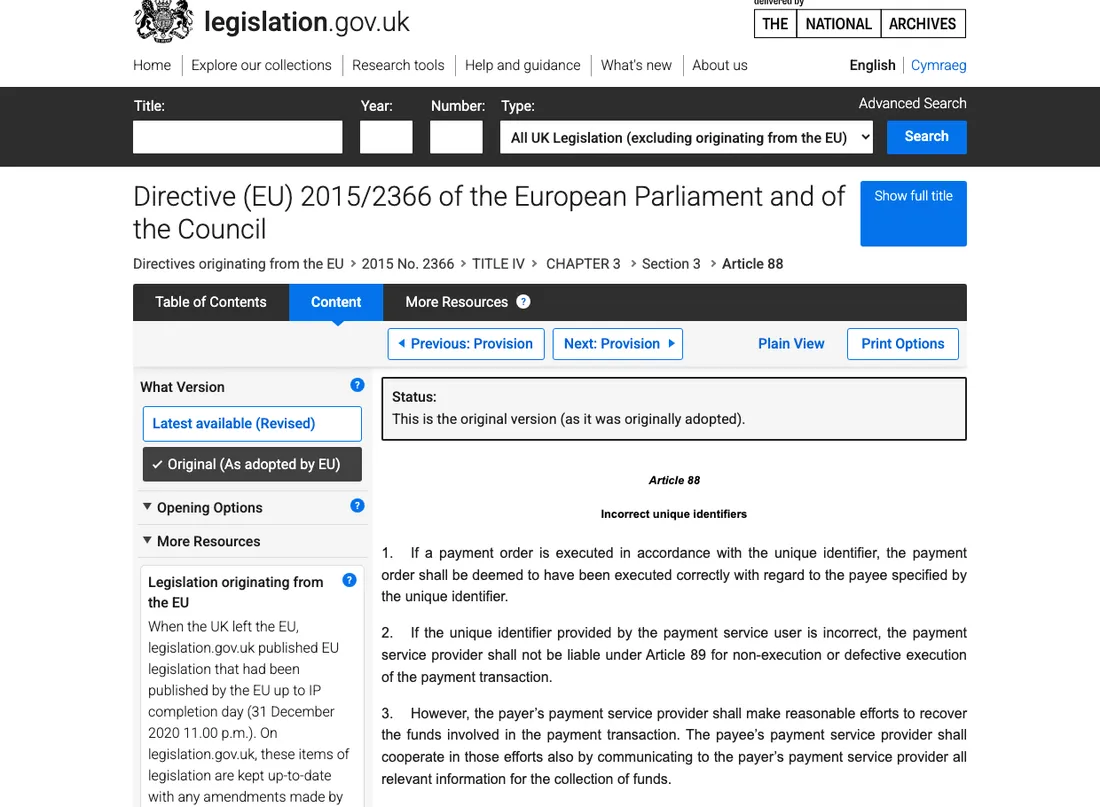
Article 88 of PSD2 is headed Incorrect unique identifiers, and for a bank transfer the unique identifier is the IBAN. Its first paragraph says that a payment order executed in accordance with the unique identifier is deemed to have been executed correctly with regard to the payee that identifier specifies.
The second paragraph follows from that. If the identifier you provided was incorrect, your provider is not liable under Article 89, the article that otherwise makes it answerable for non-execution or defective execution.
The Banco de España's Portal for Banking Customers put the same thing in everyday terms in a blog post dated 19 February 2026: when your bank executes a transfer using the IBAN you entered, the transfer is considered correctly carried out and the bank is exempt from liability, and because transfers are irrevocable the bank cannot order a refund for you.
Article 88(3) is the paragraph you can use: the payer's provider shall make reasonable efforts to recover the funds involved in the payment transaction. That is a duty to try. The article contains no sentence obliging the bank to pay you back from its own funds when the attempt fails.
Your bank works under the national law that implements PSD2 and may quote that law instead of the article number. The texts relied on here are Articles 80, 88 and 89 of the directive, the Banco de España post and the European Central Bank's page on the Instant Payments Regulation, in the versions online in October 2026. The legislation.gov.uk links show the directive in the wording adopted in 2015, so any amendment made since then does not appear on those pages.
What a SEPA recall request can and cannot get back
The word recall is not in Articles 80 or 88. If your bank gives the request that name, the legal footing in the directive is the recovery effort in Article 88(3).
The same paragraph puts a duty on the other side: the payee's provider must cooperate, including by passing your bank all relevant information for collecting the funds. It does not tell the receiving bank to debit its customer. It sets no deadline for the attempt and promises no result.
| What you can ask your bank for | Where it comes from | Condition in the text |
|---|---|---|
| An attempt to recover the funds | Article 88(3), first subparagraph | The IBAN you provided was incorrect |
| Cooperation from the receiving bank | Article 88(3), first subparagraph | Owed to your bank, so the request goes through your bank |
| All available information relevant to a legal claim | Article 88(3), second subparagraph | Recovery was not possible and you ask in writing |
| A clear answer on any recovery fee | Article 88(4) | A fee is allowed only if agreed in the framework contract |
The third row is the one to use when the answer is no. Send a written request that says recovery has not been possible and asks for all the information the bank holds that is relevant to you for filing a legal claim to recover the funds. Those are close to the directive's own words.
The directive does not list which details that information must include, and it does not say which court or procedure applies. Both depend on national law in the countries involved, so a claim against an account holder abroad is a question for a lawyer or a consumer advice body in your country.
A transfer that the receiving bank refuses on its own is a separate case, because it travels back without any request from you; why a SEPA transfer comes back deals with that.
Right IBAN, wrong reference or name on a deposit to a platform
If you were funding an account at a crypto platform and the IBAN was the one shown on its deposit screen, you are not in the wrong-IBAN situation at all. The transfer went to the account that IBAN identifies, which is the account the platform uses to receive deposits.
Article 88(5) covers the extra fields. Where the user provides information in addition to the unique identifier, the provider is liable only for executing the payment in accordance with that identifier. A wrong name or a wrong reference therefore does not make the transfer defective from your bank's side, and a recovery request would be aimed at the party you intended to pay.
The party that can find the payment is the one holding the account, so go to the platform:
- Open its help centre from inside the app or the website you normally log in to.
- Attach the payment confirmation showing the date, the amount, the IBAN, the name and the reference exactly as sent.
- Say which field was wrong and what it should have been, and give the account the deposit belongs to.
- Ask whether the payment has been located, and whether it will be credited to you or sent back to the account it came from.
The platform decides which of the two it does, so ask for the answer in the ticket. Before the next attempt, check each field against the euro deposit walkthrough.
How the payee name check catches a wrong IBAN before you send
Since 9 October 2025 a euro-area bank has had to compare the payee name you type with the IBAN and tell you before you send if they differ, as the European Central Bank's Instant Payments Regulation page sets out.
For this mistake the check is well placed. An IBAN that belongs to a stranger, entered next to the name of the person you meant to pay, is the kind of discrepancy it reports.
It only helps if you act on the result. The Banco de España post says that if you go ahead after a mismatch warning the transfer is completed, and the financial institution cannot be held liable if an error occurs. When the result is anything other than a match, stop and read what to do when your bank says the payee name does not match the IBAN before authorising.
The check compares a name with an IBAN. A wrong reference is outside it, so on a platform deposit you'll still have to compare the reference by eye with the deposit screen.