Which tax number to give OKX under the EU's DAC8 rules
OKX is asking because of DAC8, an EU tax-reporting rule; OKX says the obligations took effect for EEA countries on 1 January 2026. The box wants the tax number from your country of tax residence, and in many EEA countries that's the personal number already printed on your ID card.
A 2026 EU tax rule is behind the question
DAC8 is an EU directive that makes crypto platforms report user transaction data to tax authorities. That is how OKX's FAQ for European users describes it. The same FAQ calls it Europe's implementation of an OECD tax-transparency framework. A platform can't send anything to the right tax office until it knows which country treats you as tax-resident. So OKX asks for your tax residency details, including your Tax Identification Number “or a functional equivalent”.
The box often wants a number you already carry. In several countries on OKX's list, the tax number is the personal number printed on your ID card. Romania's CNP, Bulgaria's EGN and Poland's PESEL all work that way. You may never have been handed anything labelled “tax number” and still have one.
If you live in the EEA, your account is with OKX Europe Limited. That's a Maltese company licensed by the Malta Financial Services Authority as a crypto-asset service provider under MiCA. OKX says a third-party service provider collects and processes the tax details for it, under data protection law.
The request comes up inside the OKX app. It can appear during onboarding, or later whenever OKX needs updated information, and the FAQ gives a change of address as the example. OKX also asks you to update the app before you go through it.
Which number counts as your TIN
OKX's general answer is that the number is usually on your national ID card, your passport, or official tax papers such as a tax return or assessment. Its FAQ then has a table with a row for almost every EEA country: what the number is called, its format, and where to find it.
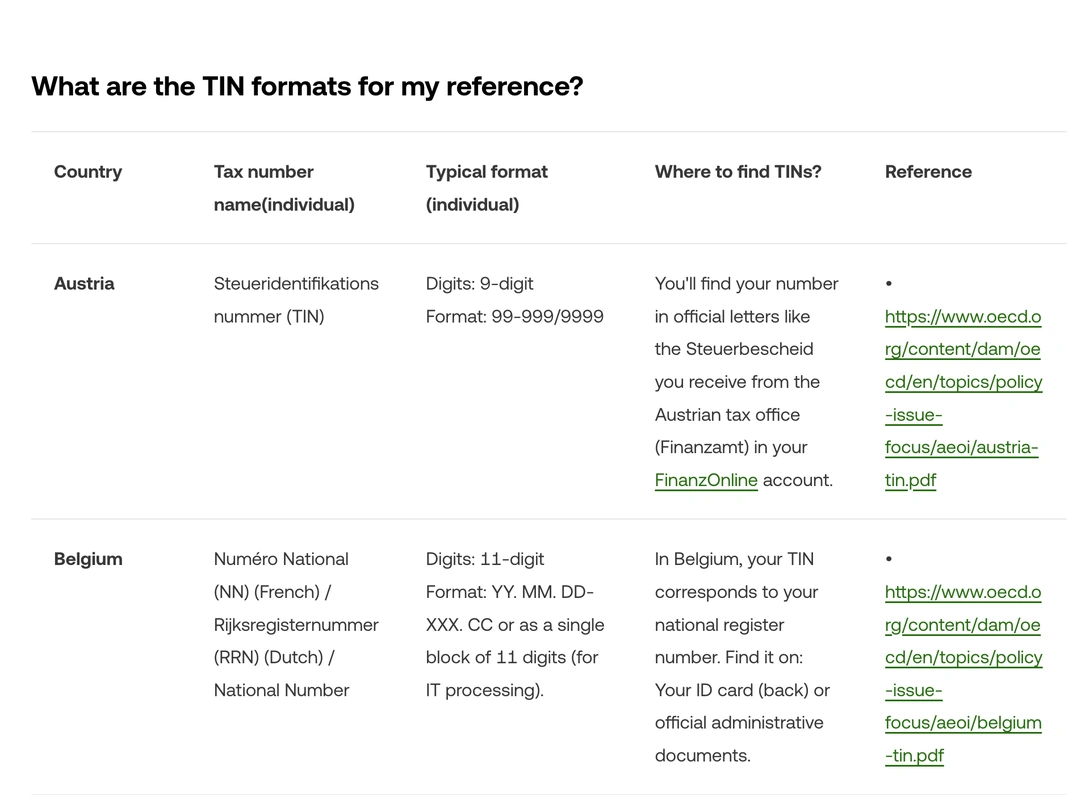
The table below takes fifteen of those rows. The formats are copied as OKX prints them. We've shortened some of the number names and the “where to find it” column.
| Country | What the number is called | Format as OKX gives it | Where to find it |
|---|---|---|---|
| Austria | Steueridentifikationsnummer (TIN) | 9-digit · 99-999/9999 | Letters from the Finanzamt such as the Steuerbescheid, in your FinanzOnline account |
| Belgium | Numéro National (NN) / Rijksregisternummer (RRN) | 11-digit · YY. MM. DD-XXX. CC, or as a single block of 11 digits | Back of your ID card; official administrative documents |
| Bulgaria | Unified Civil Number (UCN), ЕГН | 10-digit · YYMMDDXXXC (date of birth, serial number, control digit) | ID card or passport, birth certificate, tax documents, social security and healthcare records |
| Czech Republic | Personal Identity Number (PIN); Daňové identifikační číslo (DIČ) | 9 or 10-digit · 999999/999 (birthday before 01.01.1954) or 999999/9999 (birthday on or after 01.01.1954) | National ID card, passport or driving licence; tax returns, social security statements |
| France | Numéro fiscal de référence (NIF) | 13-digit · 1234567890123 (sometimes shown as 13 alphanumeric characters) | Income tax notices (avis d'imposition), DGFiP letters, your impots.gouv.fr account |
| Germany | Steueridentifikationsnummer (Steuer-ID), Identifikationsnummer (IDNR) | Usually a 10 to 11-digit number · 99 999 999 999 | Einkommensteuerbescheid, letters from your Finanzamt, annual wage tax statement |
| Greece | Arithmos Forologikou Mitroou (AFM) | 9-digit · 123456789 | Tax registration documents, tax returns, AADE correspondence, some bank documents |
| Ireland | Personal Public Service Number (PPS No) | 7 numbers and 1-2 letters · 1234567T or 1234567TA | PPS card, Revenue correspondence, social welfare documents, pay slips |
| Italy | Codice Fiscale | 16-character alphanumeric · MRTMTT91D08F205J | Health card, back of new electronic ID cards, Revenue Agency letters |
| Malta | Maltese nationals: Identity Card Number · Non-Maltese: Taxpayer Reference Number (TRN) | ID: 8 characters, 7 digits followed by 1 letter (1234567M) · TRN: 9 digits (999999999) | ID number on your Maltese identity card; TRN on tax documents from the Commissioner for Revenue |
| Netherlands | Citizen service number (BSN) | 9-digit · 999999999 (from OKX's short example list) | Passport (back), ID card (top right), driving licence |
| Poland | PESEL | 11-digit · 99999999999 | National ID card, passport; tax returns, social security statements |
| Portugal | Número de Identificação Fiscal (NIF), also “Número de Contribuinte” | Nine sequential digits · 123456789 | Citizen Card, NIF registration document, Portal das Finanças |
| Romania | Codul numeric personal (CNP) | 13-digit · 9999999999999 | Identity card, passport or residence permit |
| Spain | NIF (Spanish nationals) / NIE (foreign individuals) | NIF: 8 digits + 1 letter (12345678A) · NIE: Letter (X/Y/Z or M) + 7 digits + control letter (X1234567T or M1234567A) | ID, driving licence or residence permit; contact the Agencia Tributaria if missing |
The 9s, Xs, date letters and sample strings are OKX's placeholders. They show the length and layout. Type your own number, digit for digit, from the document it's printed on.
OKX gives two different lengths for Germany on the same page. Its table says “usually a 10 to 11-digit number”, while the short example list above the table says 11 digits. If you have a Finanzamt letter or an annual wage tax statement, copy the number from that paper rather than trusting either description.
Some formats include dots, dashes or slashes, like Austria's 99-999/9999, Belgium's dotted date layout and the Czech slash. OKX's FAQ doesn't say whether the field expects those characters. If your first entry is refused, try the digits on their own. That's our suggestion, based on Belgium's row, which lists a plain 11-digit block as the version used for IT processing.
OKX's list also has rows for Croatia, Cyprus, Denmark, Estonia, Finland, Hungary, Iceland, Latvia, Lithuania, Luxembourg, Norway, Slovakia, Slovenia and Sweden, and each links to an OECD document for that country. Liechtenstein, the other EEA member, has no row in the September 2026 version of the page.
For many readers the number is on the same ID card they photographed for identity verification, so keep that card nearby. If verification is the step that's stuck, OKX KYC keeps failing? Causes, one by one covers the usual reasons.
If you have no TIN or you're not sure which country
Your country hasn't given you one
If your country doesn't issue TINs, or you haven't been assigned one yet, OKX says you can usually select “Tax number not available” and give a reason. The FAQ's examples of reasons are student status and having recently moved. OKX records your answer to stay compliant with DAC8.
You've just moved
People who have just moved often don't have a local number yet. A few rows in OKX's table cover foreigners directly. Malta gives non-Maltese nationals and residents a 9-digit Taxpayer Reference Number when they register for tax. In Spain, foreign individuals have the NIE, which OKX says also works as the tax ID in many cases. Romania's row tells foreigners who need a NIF to contact ANAF.
If your new number hasn't come through yet, “recently moved” is one of the reasons OKX itself gives for “Tax number not available”. Once it arrives, you'll need to update your details. If the app doesn't prompt you for it, add it through OKX Assistant.
You don't know which country counts
Tax residency is set by tax law. It can differ from your nationality, and from the address on your ID card. OKX's FAQ says your answer is used to work out where you are tax-resident and which tax authorities receive your information. So if you pick a country just to get past the screen, your information may go to the wrong authority.
Your own tax office can tell you which country counts. If your life is split between two countries, an adviser can help. Each row of OKX's table links an OECD sheet for that country, and some rows name an office to contact, like Spain's Agencia Tributaria for a missing number.
What happens if you skip it?
Leaving it undone can get your account temporarily restricted. OKX's FAQ says providing the information is a requirement for using crypto services in the EEA, and that an account that doesn't provide it within the requested timeframe may be restricted until it does.
The public FAQ doesn't put a number of days on that timeframe. If the request in your app gives a date, go by that date.
To get out of it, finish the step. Enter the number, or choose “Tax number not available” with a reason if that honestly describes your situation. If your account is already restricted and you can't tell whether this is why, OKX account locked: why risk control triggers, and what to do goes through the other common causes. Then ask OKX Assistant which one applies to you.
What gets reported and by what date
The European Commission's DAC8 page describes what gets reported as “the aggregate gross amount paid or received” for acquisitions or disposals against fiat or other reportable crypto-assets, or “the aggregate fair market value” for transfers. These are totals for the reporting year, not a trade-by-trade log of your account.
The same page says DAC8 rules entered into force on 1 January 2026, and it calls 2026 the first reporting year. Whatever you do on the account during 2026 falls into that year. EU tax authorities are scheduled to exchange the 2026 information with each other by 30 September 2027.